Prototype – The Backbone of JavaScript Objects

I’m Arjun Saxena, a passionate software developer specializing in web engineering. I believe in writing code that creates real solutions to real problems. I love building efficient, user-friendly applications and constantly push myself to learn new technologies. Beyond coding, I enjoy sharing knowledge and growing together with others in the tech community.
JavaScript looks simple on the surface, but one concept powers almost everything behind the scenes:
👉 Prototype
If you understand prototypes:
Objects make sense
Inheritance becomes clear
JavaScript feels logical, not magical ✨
In this blog, we’ll cover:
What prototypes are (with a simple analogy)
The prototype chain
How inheritance works in JavaScript
Object.create(),__proto__, andprototypeDo’s and Don’ts of modifying prototypes
No confusion. Step by step clarity 👇
1️⃣ What is a Prototype in JavaScript?
Simple Definition:
A prototype is an object from which other objects can inherit properties and methods.
Real-Life Analogy 🏠 (Blueprint Example)
Think of a house blueprint:
Blueprint defines rooms, doors, windows
Many houses are built from one blueprint
👉 Prototype = blueprint
👉 Objects = houses built from it
If you add something to the blueprint, all houses get it.
2️⃣ JavaScript Objects & Prototypes
In JavaScript:
Every object has a hidden reference to another object
This reference is called its prototype
const user = {
  name: "Arjun"
};
👉 user automatically links to a prototype object.
3️⃣ The Prototype Chain (Very Important)
When you access a property:
user.toString();
JavaScript looks for it in this order:
On
userOn
user’s prototypeOn prototype’s prototype
Until it reaches
null
This lookup path is called the prototype chain.
🌳 Prototype Chain Diagram

Example Chain:
user → Object.prototype → null
4️⃣ Practical Example of Prototype-Based Inheritance
const person = {
  greet() {
    console.log("Hello!");
  }
};

const student = Object.create(person);
student.name = "Arjun";

student.greet(); // Hello!
What’s Happening?
studentdoes not havegreetJavaScript finds it in
personInheritance works via prototype chain
5️⃣ Understanding Object.create()
What does it do?
Creates a new object and links it to a prototype.
const car = {
  drive() {
    console.log("Driving");
  }
};

const myCar = Object.create(car);
myCar.drive();
✔ Clean
✔ Explicit
✔ Recommended for prototype-based inheritance
6️⃣ __proto__ vs prototype vs Object.create()
This confuses many beginners — let’s simplify.
__proto__ (Internal Link)
myCar.__proto__ === car; // true
Points to the object's prototype
Exists on instances
⚠️ Avoid using directly in production
prototype (Constructor Property)
function User(name) {
  this.name = name;
}

User.prototype.sayHi = function () {
  console.log("Hi");
};
Exists on constructor functions
Used when creating objects with
new
Comparison Table
| Feature | Object.create() | __proto__ | prototype |
| Used on | Objects | Objects | Constructors |
| Purpose | Create inheritance | Access prototype | Define shared methods |
| Recommended | ✅ Yes | ❌ No | ✅ Yes |
7️⃣ Constructor Functions & Prototypes
function Person(name) {
  this.name = name;
}

Person.prototype.introduce = function () {
  console.log(`I am ${this.name}`);
};

const p1 = new Person("Arjun");
p1.introduce();
✔ Method shared across all instances
✔ Memory efficient
8️⃣ Classical vs Prototype-Based Inheritance
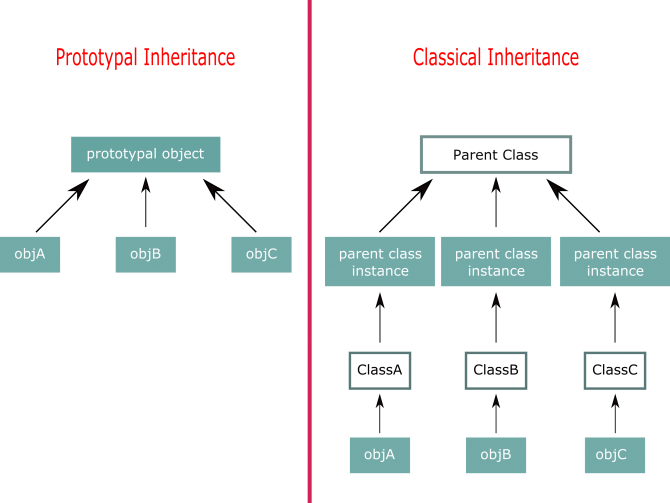

| Classical (Java, C++) | JavaScript |
| Class-based | Prototype-based |
| Rigid structure | Flexible |
| Inheritance via classes | Inheritance via objects |
👉 JavaScript uses objects inheriting from objects
9️⃣ Modifying Prototypes – Do’s and Don’ts
✅ Do (Safe & Controlled)
function User() {}

User.prototype.login = function () {
  console.log("Logged in");
};
✔ Add shared methods
✔ Improves memory usage
❌ Don’t (Very Important)
Array.prototype.myMethod = function () {};
❌ Can break libraries
❌ Unexpected behavior
👉 Never modify built-in prototypes (Array, Object, etc.)


